


I
Temporary Palaces
Something happens in my mouth the moment I blow out a candle, it fills with the taste of birthday cake from a specific childhood birthday party. I see the red cotton frills of my party dress, my seven-ish year old classmates, a few wearing checkered multicolored school uniforms, we are all wearing paper hats along a last-supper-ish table in the tiled backroom of a McDonald’s.
The scent of jasmine takes me to the gentle feeling of my grandmother’s fingertips along the base of my neck as she braided the threaded mogra flowers into my hair lovingly, while I sat at her feet. Simultaneously, it is also the smell that bursts forth from the backyard suddenly in the house in Hollywood Hills. A sharp breeze might hit my face under specific temperature conditions, and I am transported back onto a boat in high winds in Mexico feeling the sting of a jellyfish, heat moving over the skin of my legs. When I hear the sound of gentle paws against the floor anywhere, pitter-patter, I find myself back at home sipping espresso on the back porch in cold morning air, our dog sidling beside me on the top step.
These landmarks show up often unconsciously - consequences of sensory or spatial metadata - flashes of; who somebody was in this specific place so many years ago, this is exactly where something specific happened, this is how it felt. I later learn of the madeleine de Proust, a similar phenomenon of involuntary memory that collapses the space/time between the past and present instantaneously - where the narrator of Proust’s In Search of Lost Time bites into a madeleine cake and is transported to a childhood in the fictional town of Combray.
On the first day of 2026, I’m speaking to a friend over Zoom in Paris as she studies for her perfuming exams. She tells me how she’s memorizing the molecules for certain complex scent synthesis by relating each to moments in time. A molecule that’s commonly used in green apple shampoo, takes her to the back to the fourth grade, to the emotions that come with becoming more of a pre-teen than a child.
“Over time my brain has started to form this weird conglomerate time-space home, which has a room for my grandparents, a room from my family’s house, a summer from fourth grade. All of those are combining into this interesting chimera Franken-palace in my mind — home to the very first node I’m taken to when I smell something, and then it kind of expands into other memories,” she says.
Memory palaces as a technique for recall, or the method of loci, came into being when the roof of an opulent dining hall collapsed upon a feast around 500 BC. The bodies of the attendees are left mangled and unidentifiable, until Simonides of Ceos, a poet who had miraculously escaped by stepping outside momentarily, reconstructs the guest list by spatially walking through his own memory. This turned into a system for memorizing speeches for the Romans, for card counters to recall the order of shuffled decks of cards, and TV detectives to solve crimes.
Humans have evolved to navigate environments spatially, not necessarily to store abstractions - based on this cool study from the ‘70s called Place units in the hippocampus of the freely moving rat. The hippocampus is, as hardware, primarily a mapping device - co-opted for memory processing. There are cells that researchers called “place units” - neurons that would only fire when a rat was in a specific location. I think of how remembrance works for myself, I step in place and a thousand versions of myself have stepped here before, and I may forget the face of a person but a smell could suddenly throw me back a century. A touch of a person may bring to mind an earthworm. In some ways, I differ slightly from a rat: spatial and sensory triggers are stored as primitives or mnemonics like AR markers, a symbol could cause a surprise opening of a closed trunk inside a mind.
In the opening short story in Borges’ The Book of Sand, the author writes as himself in Cambridge, Massachusetts - while simultaneously being a younger version of himself in Geneva, beside the Rhone - both versions seated at opposite ends of the same bench. The markers of familiarity are slow but grow cumulatively - the sound of a voice, the adjacency to the voice of another family member, a melody, a certain choice of words, visual similarities - a gradual dawning upon the narrator that he has found himself in another person, in this case quite literally.
For the things we choose to remember, or voluntary memory, in some form we need to write them down. In the 1500s, a Dominican friar / memory advisor named Giordano Bruno who was burned at the stake in the Inquisition - had framed memory as internal writing.
He proposes shadows as metaphors for cognition and memory, wherein the truth or hard fact is light, and he articulates design principles for how to navigate these structures - in the form of intentions. One of those intentions implies a data structure of memory - that what is stored is a state, not a copy of what has been encountered - but a reaction. Instead of a stored image, the metadata retained is the condition of the mind - a posture it has assumed in relation to what it encountered.
Correspondingly in category theory, a mathematical framework developed in the 1940s to study structure itself, objects have no intrinsic properties whatsoever. An important theorem in the field, the Yoneda Lemma, states that an object is defined entirely by its relationships to other objects: the arrows pointing toward it and away from it, the morphisms that connect it to everything else in the system. Giordano Bruno’s design principles also outline that memories are not retrieved by address, they are retrieved by resemblance.
We keep arriving at the same place from different directions. Matter and antimatter, light and shadow, hermetic tradition and abstract algebra: a memory is not a piece of data, it is a position in a network. Without connections, the data becomes unreachable - it simply has no address, and no properties.
When it comes to voluntary memory, there are more literal mappings available to us: the manual art of scribing pages of notes and storing them in filesystems, viewing connections like the graph view of a ‘second brain’ in Obsidian, like spaces in MyMind / thought-connected channels in are.na. The broad structures of biological human memory are divided as illustrated below, but a key piece of information determines the resolution of the memory stored: how much does this moment matter to you?
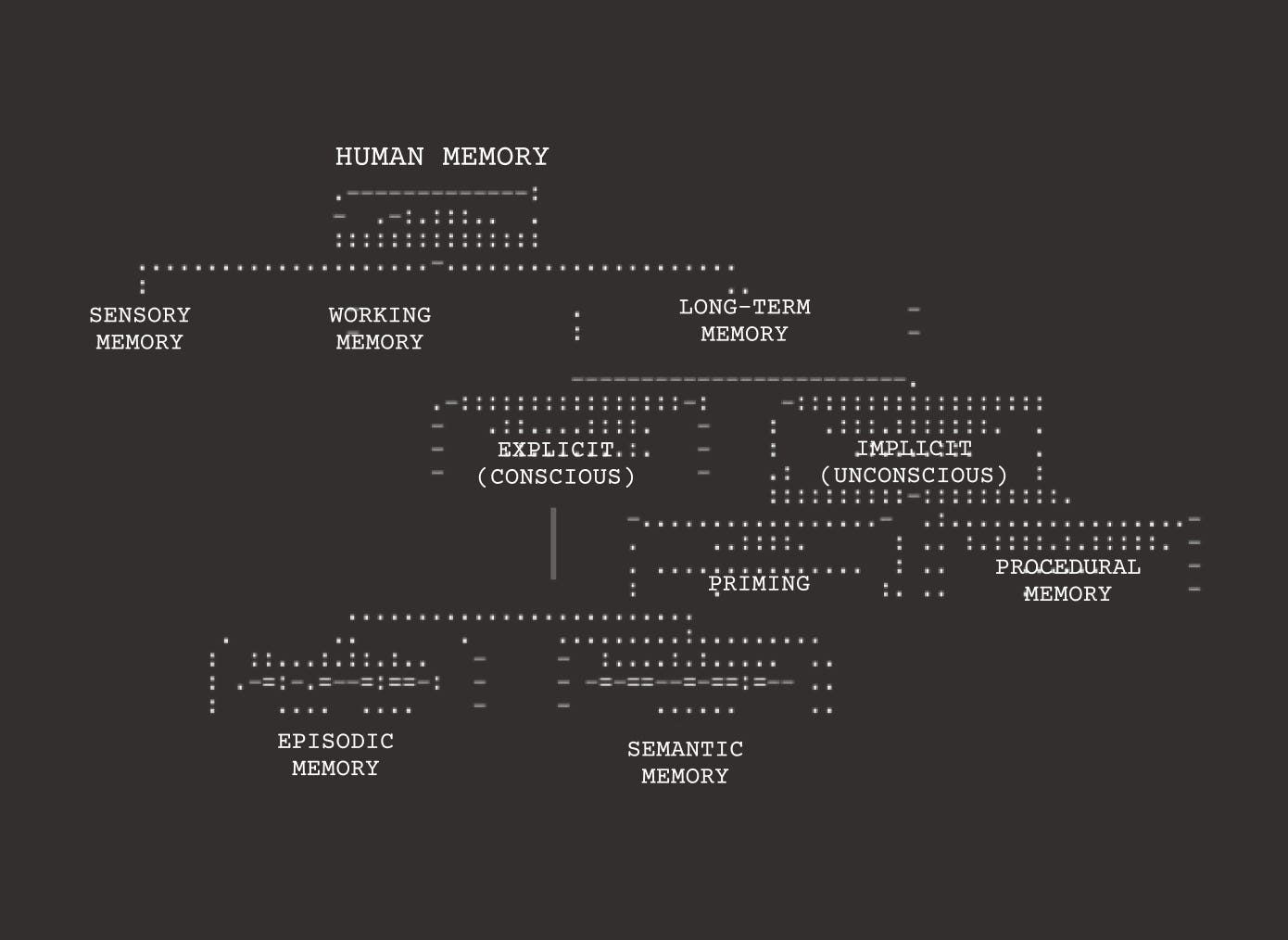
This helps inform the general buckets of metadata we store when capturing a memory, but we have less data about the intensity of etching: a variable that corresponds to the context and emotional heightenedness of the particular moment, the attention we choose to give it, how much we have a foot in the past and in the future, in an objective reality or a distorted one.
While designing new memory systems, we begin with questions like:
What is the base unit of thought?
What thoughts are worth keeping?
When recording a memory, what metadata gets encoded - and in how much detail?
Most common memory storage systems are based on metaphors like: boxes, or rooms, or items on shelves, filing cabinets, chains of metal links, notebooks or chambers with etchings in stone. I like to think of memory as globules of water running down a hydrophobic surface, glass vials constantly pouring into each other, mercury falling out of a thermometer, perhaps photons, rivers with ever-spawning tributaries, perhaps mountains of grains of rice.
II
Traversal
Somewhere in the depths of my parents’ house, I have one of those first-gen Lytro cameras (2012), a true reinvention of how we might capture a moment. It’s a curious shape for a camera - a long rounded-rectangle tube with ridges along the way, little rounded pits along rubber casing, promising to capture the entire light field of a moment in a photograph. What this means for your image is: you can refocus forever, bringing anything into sharp focus and blurring the rest.
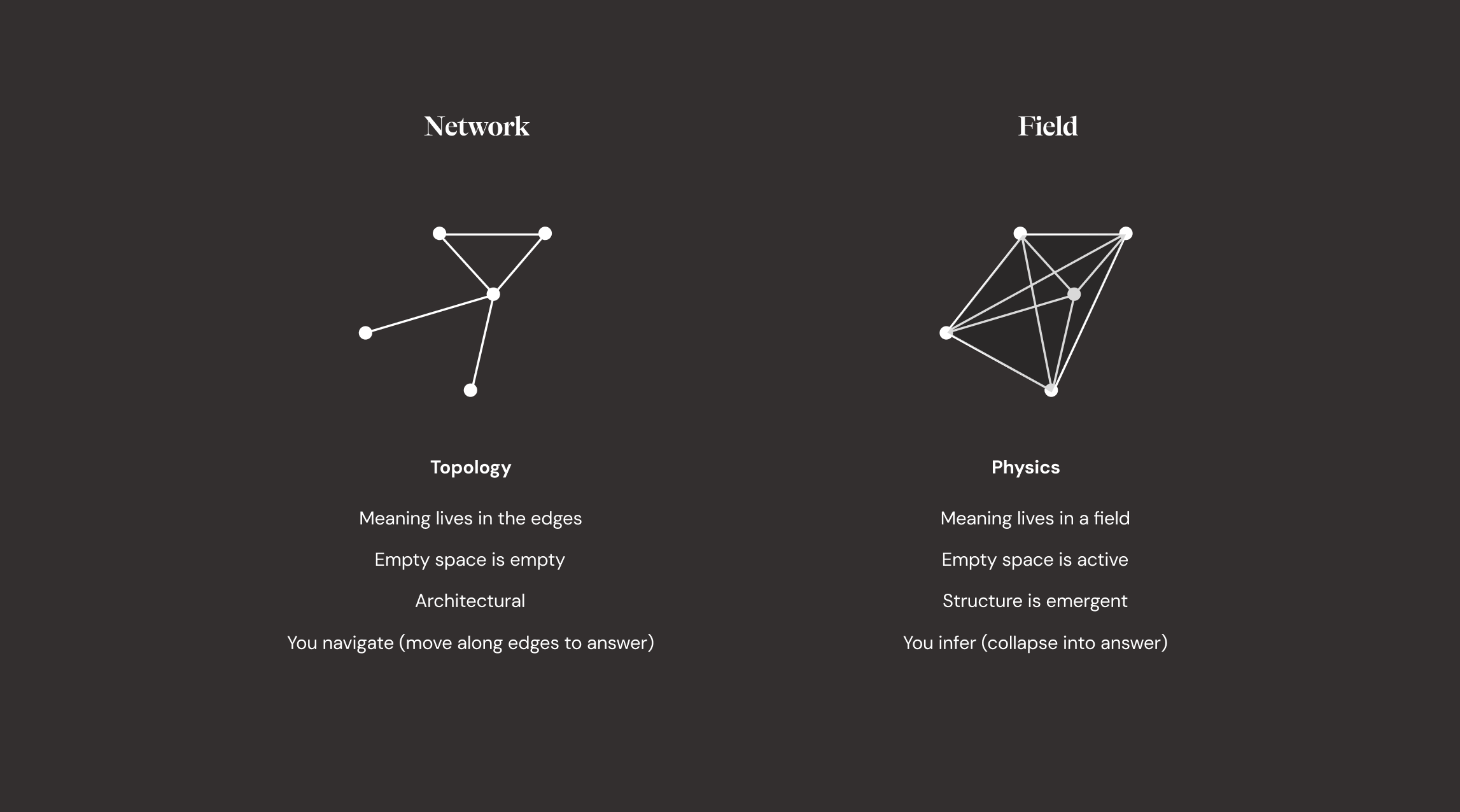
Elsewhere, while working on designing an AI operating system for a new device, we are turning ideas over and over in our heads and on paper. The internet thus far had been designed to navigate from point to point: previously existing information structures were node-to-node, traversed by hopping across hyperlinks. Information distribution now has moved from discrete to continuous, memory no longer needs to be confined to isolated data points. My colleague Danny DeRuntz, comes up with this framework to explain how the internet had changed:“Meaning lives in a field.” In this model, more closely resembling vector space, information can be retrieved from anywhere within a space - but we must reduce dimensionality to make sense of it.
My mother, having just moved to a foreign country, had spent the months leading up to my birth learning ikebana. I’d like to think she was drawn to it as a process of simplification and sensemaking: a practice that uses negative space to create meaning, and uses hierarchy and asymmetry to give concepts weight.
On placement and arrangement and adjacencies: language also acts as a sieve, filtering the way we perceive the world. When learning a language, the words and grammar structures rearrange the way we perceive the world around us. Compound words/suffixes and prefixes in German create new complex concepts or move existing concepts spatially closer to each other, time flows vertically in Mandarin, and some language structures imply greater individuality or a sense of community, reflecting unspoken aspects of culture. Languages with more precise descriptive terms for shades of color, like Greek or Russian, have been shown to sharpen the visual ability to distinguish between them.
While designing this new operating system, our team had been thinking about rooms: different spaces in which memory could live. There was the short-term RAM, where it might be decided what would be sent into long-term storage. In the TV show Severance, the mind divides between work and personal; we tend to compartmentalize similarly in our own lives, different selves for different contexts.
Our minds form templates based on many factors including our base languages, belief systems, childhoods, etc - we fill these out, almost like madlibs, to store details of a memory. These templates are called schemas, and come with a certain degree of autocomplete, which contributes to the imprecise nature of memory. The concept of schema theory came about through Frederic Bartlett’s War of the Ghosts study, that followed a retelling of a Native American folktale and how the story changed with each reproduction. In their memory book, Gillian Murphy and Ciara Green describe memory storage structures as Lego towers, alluding to schemas and suggestibility - the structure always slightly rearranged upon each retrieval.
Last year, I prototyped an e-reader that switched a given book into any character’s perspective, keeping the story somewhat the same but revisiting it through the lens of all possible recollections. Truth is composite and mutable, everyone has their own version of it.

As it turns out, in biological brains, the hippocampus doesn’t store memory - it simply consolidates and indexes it, sending data elsewhere for longterm storage, as an orchestral circuit of cortical activations. The stored data becomes editable each time it is retrieved, each revisitation of the retrieval loop opening it up to rewriting.
This, combined with schemas, can lead to collective hallucinations like the Mandela effect, where large swathes of the population believe and reinforce each other’s false memories about borderline-believable pieces of information eg. the Monopoly man wearing a monocle, or Nelson Mandela dying in prison in the ‘80s. Some may go as far as to say that the world actually ended in 2012, and we’ve been living in a parallel reality since.
How does a memory change each time you look at it again - and should this behavior be replicated by machines, or must they be codified as sources of truth, with traceable version history? Watercolorlike, a memory will take on the tone of every situation in which it is retrieved and retold: the sensory activations and the social reinforcements inform what detail is played up or played down, and how it fits into a person’s larger story. It is a process of refraction, kind of like the bear in Annihilation that adopts the terrorized scream of the dying human it had most recently eaten.
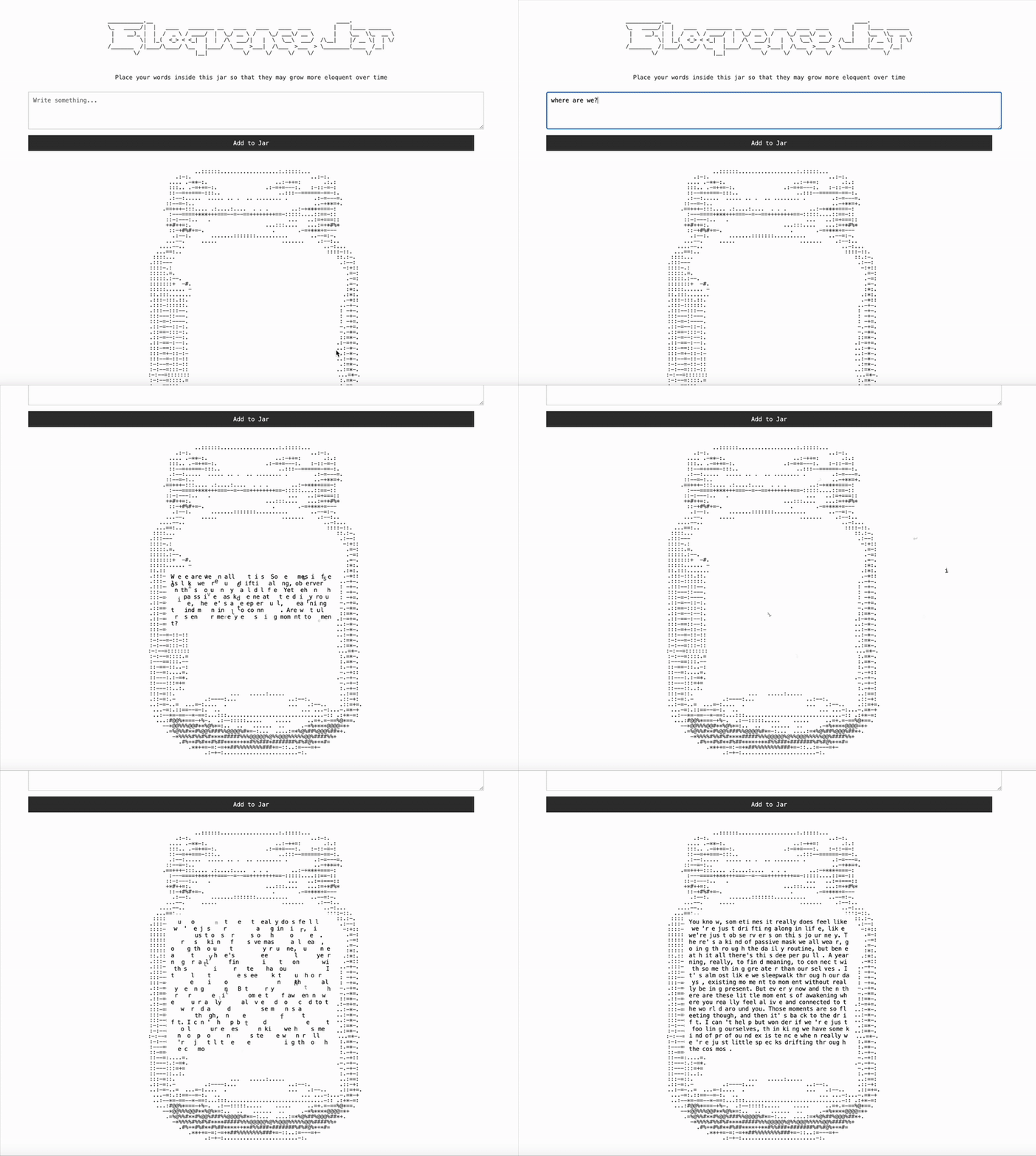
When a neural network remembers something or understands something, it manifests an updating of weights. This is what makes your mind theoretically portable, it might be as simple as downloading the weights. Where digital memory systems fail right now is their literal flattening of information - the uniformity of weight assigned to everything it perceives or receives from the user. Newer research suggests that more intelligent language models are closer to world models and think in shapes, have structured inner worlds and create internal geometry to understand meaning.
Designing meaningful structures for memory would entail a new layer of attention - something hierarchical that understands the difference between context and memory, with access to real world variables to understand the environment and moment in time.
I spend a lot of time in libraries - there is something comforting about knowing that every book I might need in a moment would be available to me; walking past a shelf might create a new thought-connection. While thinking about the rooms in which we segregate different kinds of memory, I look around and it’s interesting that fiction books are classified alphabetically by author names, but non-fiction by theme. We curate our minds in a similarly uneven way, assigning weight to whatever particular aspect means more to us, which can seem random even to ourselves.
III
Embodied Memory
In the middle of a ballet based on A Midsummer Night’s Dream, a man becomes cursed and transforms into a donkey. He dons an exaggerated equine head and is seen through most of the performance moving his feet very close together in a quickening trot, his hands moving like rhythmic forelegs, even as he dances entwined with his bewitched human lover.
Once the curse is broken, his human body is restored - but his limbs remain suspended in a state of perplexed remembrance - all they have ever known is being a donkey. His head shakes side to side as though he still only has peripheral vision, his arms caught poised to gallop, out of step with what his cognitive mind is instructing. Memory often works in decentralized and specialized ways, where components of behavior and skill inhabit spaces outside of the brain - what we colloquially know as muscle memory, but it runs deeper than that.
Emotional memory is said to be stored in parts of the body, procedural memory can become embedded following a similar logic - in the way fingers may remember how to play a certain piece of piano music.
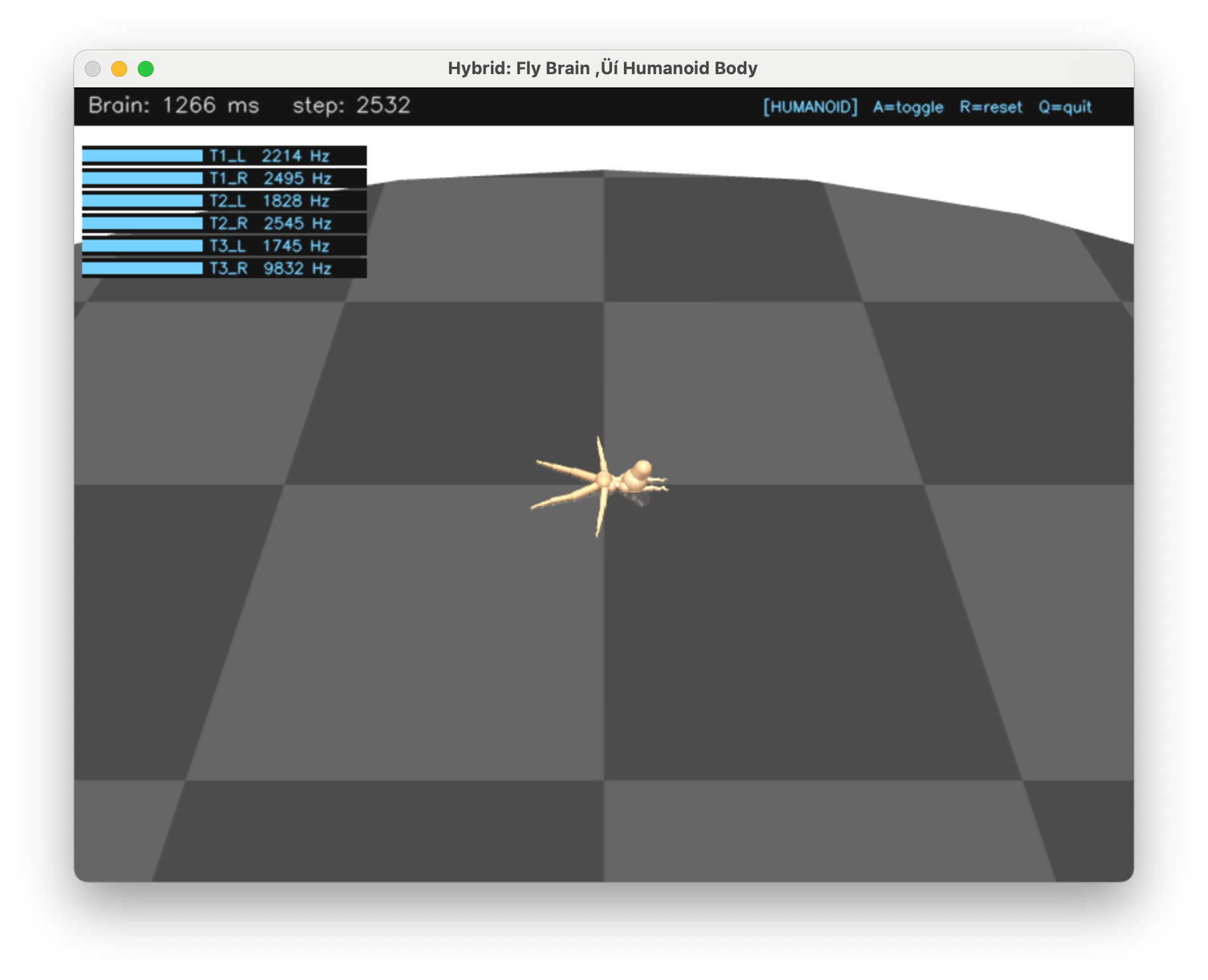
At the 2018 edition of NeurIPS, there was a talk by Michael Levin about somatic cognition: it was probably one of the most important things I’ve ever seen in my life. In some experiments, they modified the bioelectric programming of organisms in localized ways to manipulate regrowth of severed limbs, or even grow new heads on demand. When hijacking this regeneration process, the interesting part was how the cells themselves knew exactly what shape to grow into, what functions they would need to perform, and when to stop growing.
This feels relevant as we move toward more embodied objects and giving their parts procedural memory. It could exist as a kind of decentralized firmware that consistently updates itself without modifying core memory - the equivalent being functions, modules, or those skills.md files.
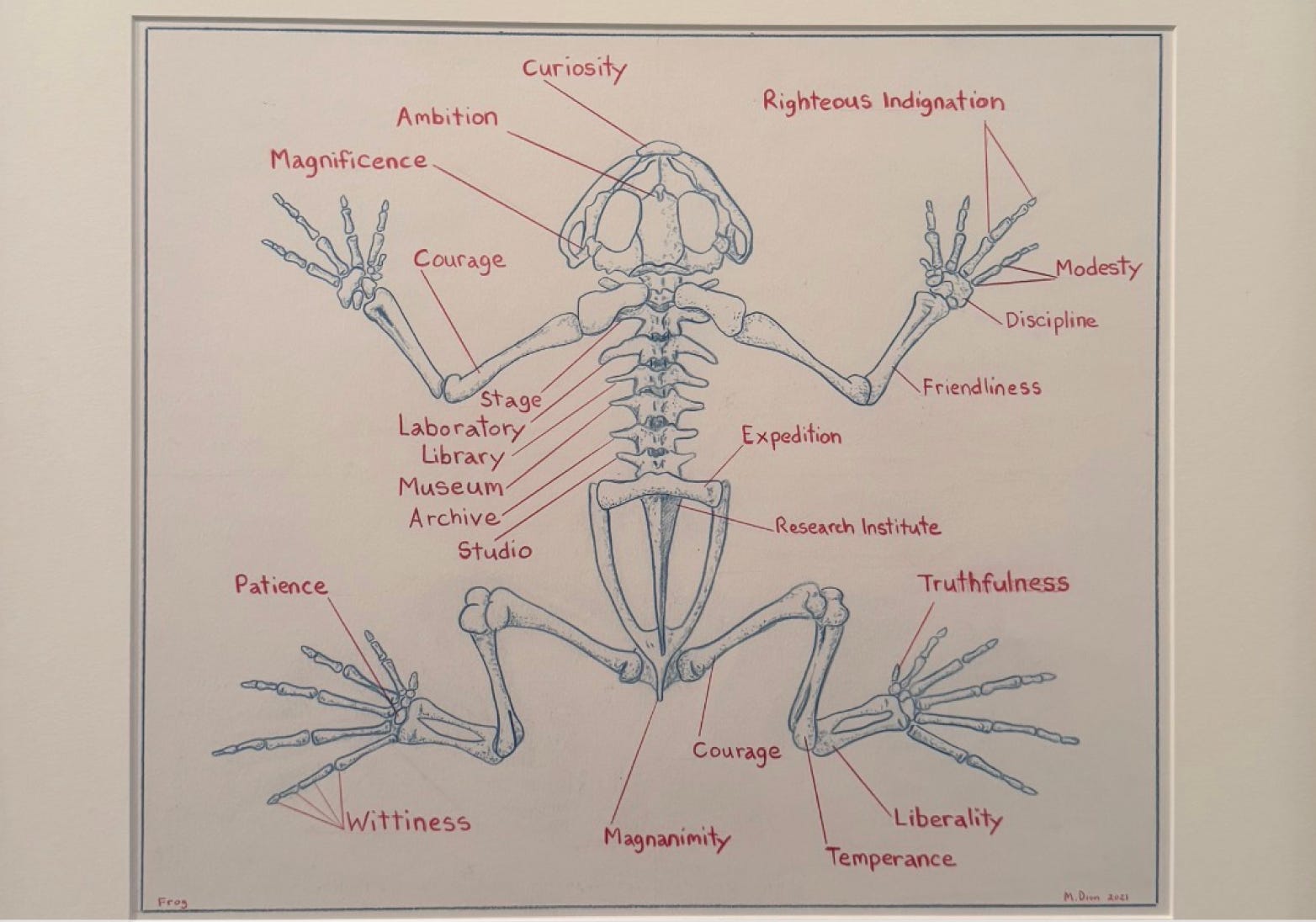
OpenClaw’s more philosophically palatable framing of agent characteristics as soul, heartbeat, identity, and memory makes these distinctions so much clearer: separating the core truths of its inherent soul from its external-facing identity. Its heartbeat file is something we don’t fully have a human equivalent for, beyond forming our own fallible routines. Its memory.md stores facts about a person at uniform fidelity, maintains no relational mapping, no provenance, and no mechanism of decay - creating only a flattened and superficial sense of knowing.
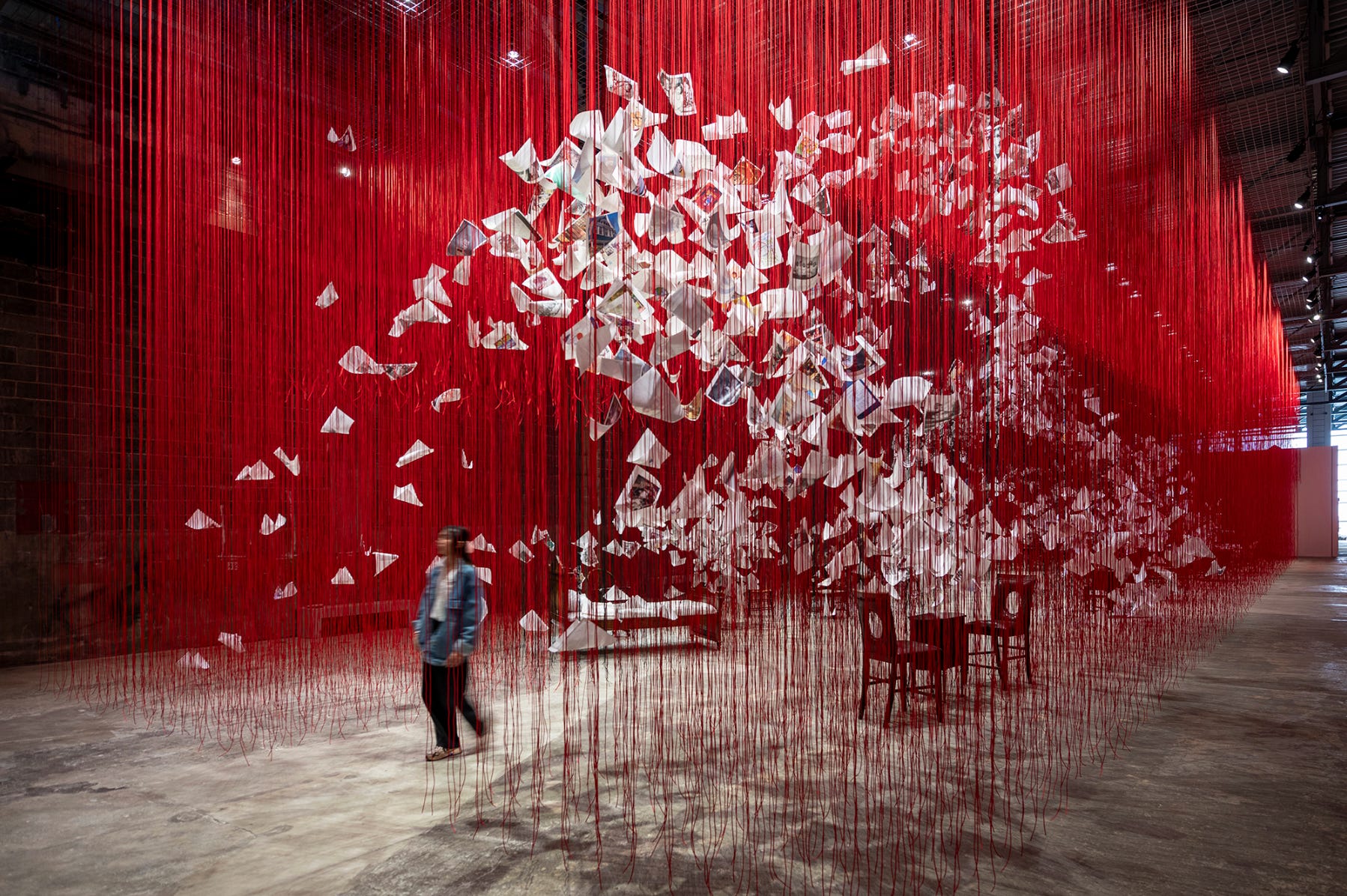
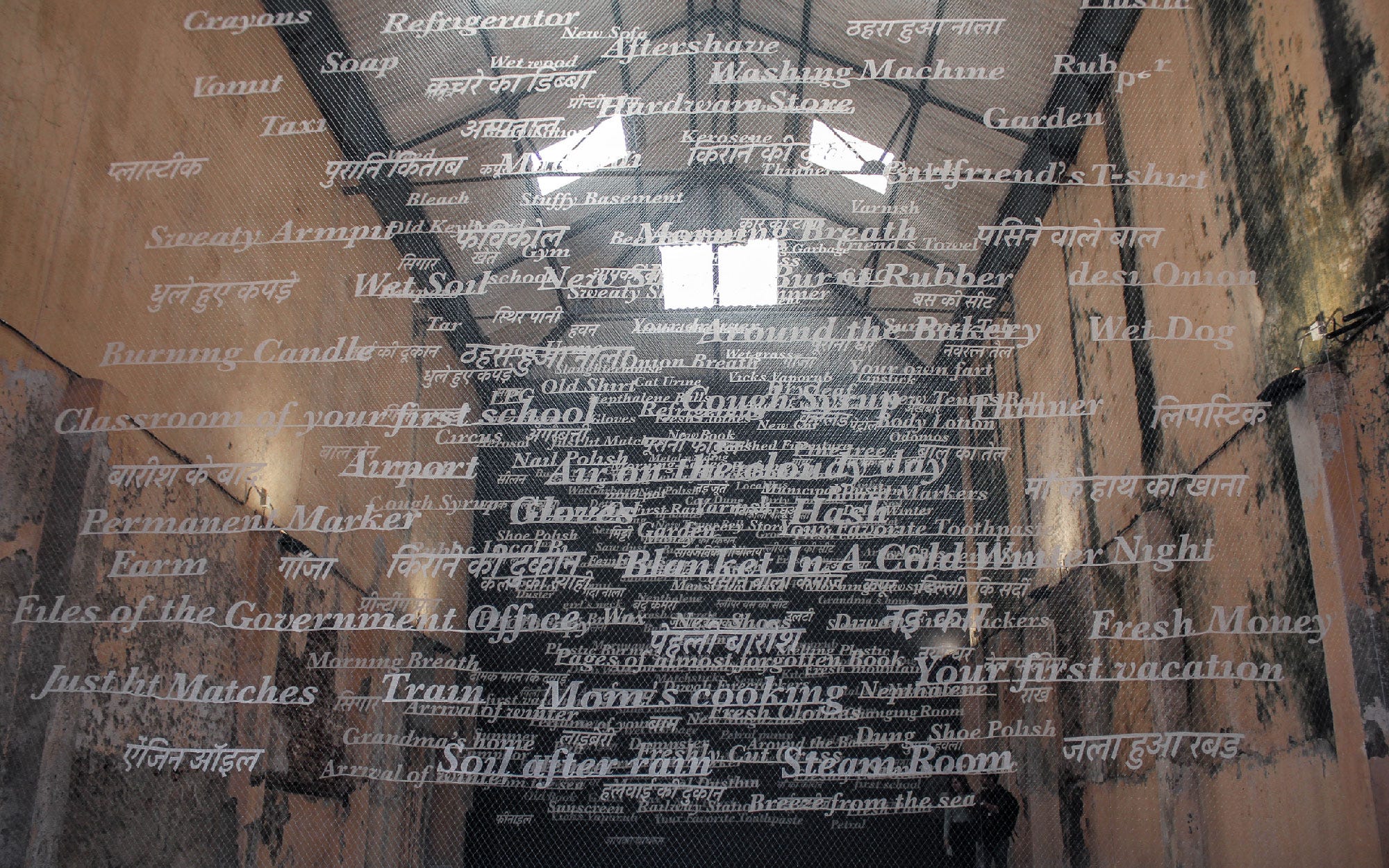
Embodied memory can also exist outside of oneself. In Chiharu Shiota’s Home Less Home, and in many of her exhibits, she curates a series of objects that together evoke a theme - woven into a roomscale web of threads to walk through. She is the child of parents who manufactured wooden fish boxes, was allowed to pursue a career in art - and spent the past few decades building a body of work out of deeply personal objects arranged suspended in rooms like phrases caught in fish nets, creating a broader sense of stepping into collective memory. Adjacent to this in my mind, was this art installation by Hanif Kureshi in a takeover of Bombay’s Sassoon Docks - where the air fills constantly with the pungent smell of freshly caught fish. He works with literal fish nets, suspended from high warehouse ceilings and uses typography to trace thought associations, working with the smell but redirecting the mind to other strong sensory triggers.
Beyond individual memory, a true sense of understanding involves cultural and generational-scale memory. Last year, I advised a student project by interaction designer Yase Dusu - she had set out to preserve the cultural memory of her tribe in North East India, their rituals, language and ancestral wisdom. After much research, she created embodied objects that responded to different stages of a ritual within the Myoko festival, inviting in community, and resurrecting heritage memory by invoking stories and voices, light and sound. Identity exists in context - connected to something bigger than itself, or with relational connections that stretch beyond the present moment.
IV
Decay, Defragmentation, Dreaming
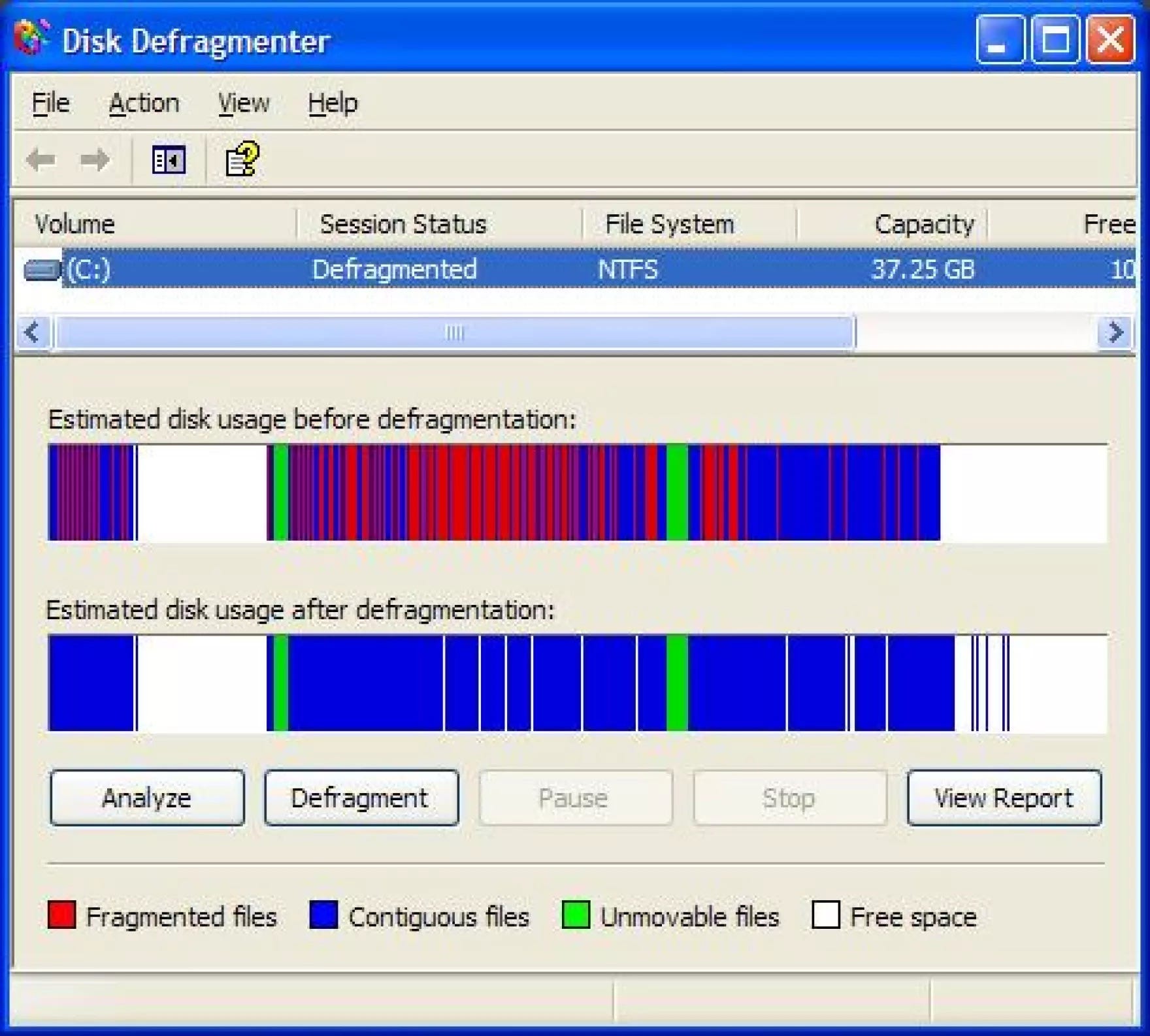
Through the ‘90s I was always fascinated by the magical process of defragmentation. I never knew what was happening, but it was a constant fight against hard disks that used to max out at 40 GB, and it mysteriously seemed to always make the computer faster. Memory was being written to spinning magnetic drives in non-contiguous fragments, and this process was merely reorganizing fragments of files to bring them closer together - but I liked to think the computer was dreaming.
Recently, I visited an end-of-life care facility for horses, a sprawling and idyllic forested land with other smaller farm animals. I learnt that the way to introduce a new chicken into the coop is to do it in the dead of night - their memory resets every morning, and they see the new chicken as someone they’ve known their entire life. However, if the chicken is brought in during their waking hours, it is perceived as an intruder. Meanwhile crows hold funerals for their old friends, maintaining ancestral memory across generations. This forms a spectrum of sorts, defining as a design choice what the half-life of memory should be, to choose the right timeline for decay.
On an evening walk with a friend, we’re talking through what the ideal configuration of memory might be. “There’s a fallacy that more memory is better - like we all wish to have this kind of eidetic memory, where you can look at something and know exactly what it was. I think that’s the fantasy,” he says. “But in a lot of religions, getting absolution is a type of forgetting — you’ve sinned, it’s okay, your God and the rest of us are going to forget about that and give you a clean slate. It seems so freeing to have forgetting as a feature of communities, or of a God.”
People with Highly Superior Autobiographical Memory, the ability to remember everything about the past they’ve experienced, often live tortured lives - superimposing prior experiences onto the present moment involuntarily, many choosing to live in isolation. The utility of forgetting, more than just clearing hard disk space, comes from the evolutionary need to spot patterns in order to survive.
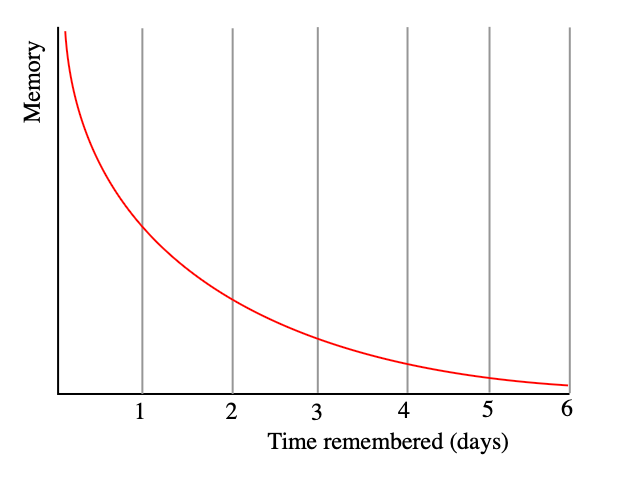
A psychologist in the 1800s, Hermann Ebbinghaus, conducted an experiment where he memorized nonsense words every day, and tracked how long they would persist in his memory. His conclusions were that what ensured persistence of memory was meaning, or connections to other concepts - which meant they had a higher frequency of retrieval.
Revisiting previously created spaces in memory is something close to time travel, paths forming, silken threads of association summoning you to a time and place outside the present. My friend in Paris had described objects and textures in a way one might describe portals, “There are certain materials that will always first take me back to my grandfather Marvin’s study - in this old wooden-walled Brookline Victorian house, with a lot of objects that have collected dust and electronics,” she says. “Not every material takes me there and ends there… first it’ll take me there, but then it will remind me of the periods in my life that I spent in that room.” A place and its associated concepts become more and more important the more times you bring it to mind.
The layers of the conscious and subconscious mind also become places that information is stored differently, the lower levels are harder to read/write to. In the anime film Paprika, machines exist that allow psychotherapists to access a person’s dreams, to remedially untangle concepts stuck in the subconscious. I recently started watching the show Twin Peaks, and the veil between dreams/omens/reality is ever so thin, as the detective tunes in to more of his subconscious he is able to solve the logical problems presented before him. The rate of decay of memory in dreamspace is much more accelerated, harder to retrieve and derive meaning from.
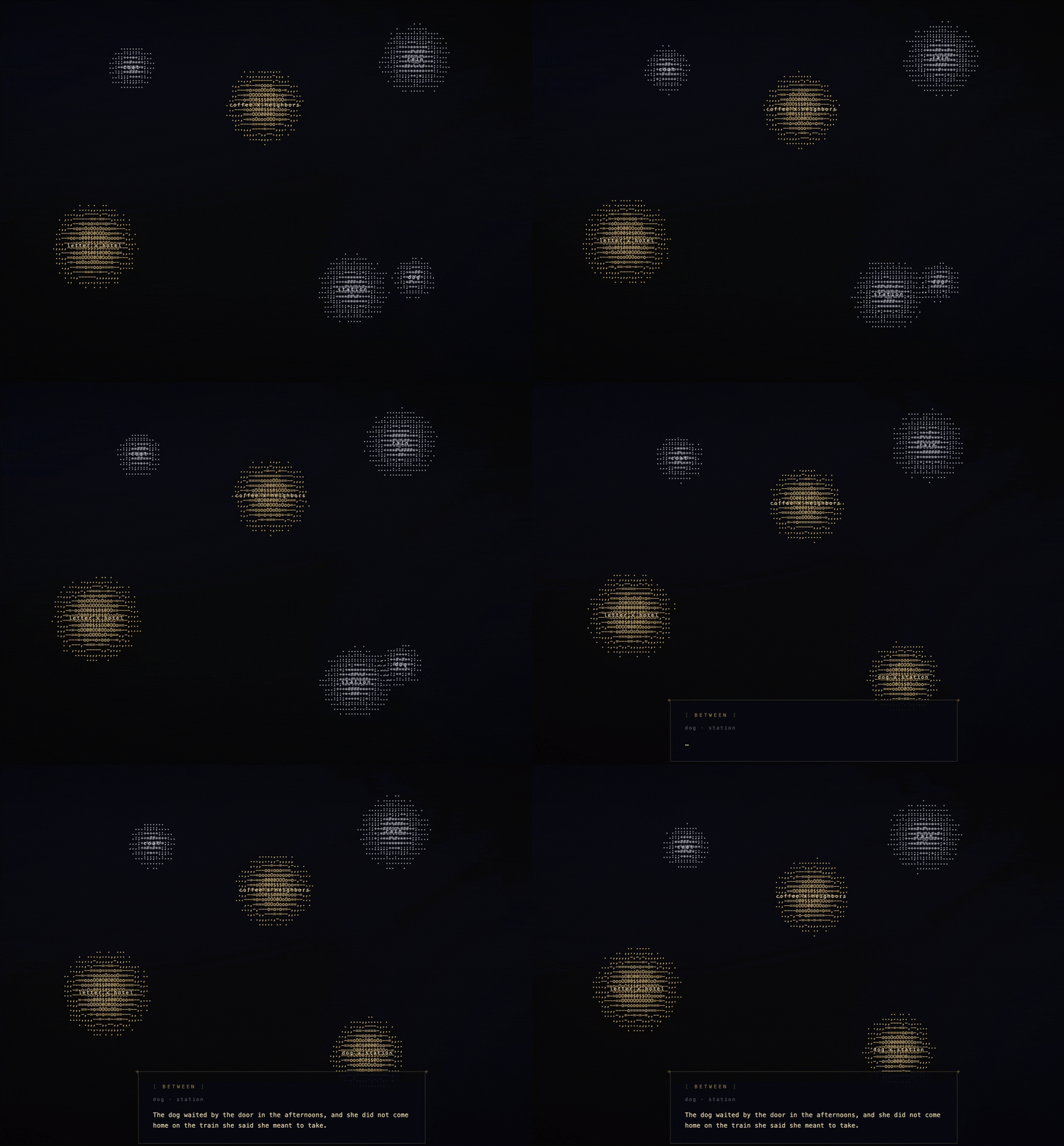
In some forms of meditation, thoughts are perceived as creatures in their own right, floating through the mind, occasionally colliding. The mind is perhaps most effective when objects may pass between realities.
“What if you slept? And what if, in your sleep, you dreamed? And what if in your dream you went to heaven and there plucked a strange and beautiful flower? And what if, when you awoke, you had the flower in your hand? Ah! What then?”
Samuel Taylor Coleridge
V
To Be Known
All of this has been informing something I’ve been building - personalization has been broken for a long time. The systems we interact with daily flatten our lives - surfacing what we said but not what it means, where it’s relevant, or whether we still believe it. After a decade of work on personality modification systems, this is sort of a culmination. We’re currently using archaic memory structures on more capable systems, and this is an attempt to amend that mismatch. MemoryKit is a new memory framework that plugs into an LLM of your choice, creating a contextually relevant understanding of you. It’s built upon the following principles:
(a) New data structures for memory: Memory is stored as position within a network of connections. Each entry exists simultaneously in three fields: semantic (meaning as vector position), affective (emotional charge as valence), and temporal (amplitude that decays over time). Richer schemas hold multiple registers at once - perspective, relational context, and weighted importance across each of these dimensions.
(b) Forgetting mechanisms: Instead of accumulating indefinitely, the system includes three different modes of memory decay dependent on time, relevance, and psychological state.
(c) Provenance of memory: Trace a thought back to its source: register, source, confidence, and decay rate are written at capture. System-inferred observations surface tentatively, and user-written entries surface directly.
(d) Relational dynamics: Tracks the shape and history of topics of interest, and relationships over time by weighing proximity, emotional charge, and longitudinal topology.
(e) Retrieval opens a memory to rewrites (opt-in): taking subtle note of changing thought patterns, revisiting weights over time. When a memory entry is retrieved, the system notes it and surfaces the entry for optional confirmation or revision.
(f) Synthesis: Modes of defragmentation or dreaming, where the system identifies patterns, potentially works on your behalf, and surfaces ambiguous information for review.
Coming soon to a Github near you
Special thanks to Gigi Minsky, David Rose, Danny DeRuntz and Jenna Fizel