


We took the ferry to Governor’s Island in the light rain of the morning. Helicopters descending like houseflies around us as we gathered around a woman in flowing red robes inside a candlelit room in a small house on Colonels’ Row. We were here to attend an AI séance, and to bear witness as someone surrendered themselves as a body to GPT. The last time we had all been in the same place was in San Francisco, after a night surrounded by blurry art exhibits and fog machines, eating fried chicken on a rooftop we broke into moments before sunrise, this was the only fitting kind of reunion for us.
The woman stood within a circle of flame, a bundle of electronics strapped to her right wrist. Everyone sat on the floor forming a larger ring around her, we crossed our legs and lowered our heads down, filling the room with a deep quiet. An unfortunate announcement soon followed: we could not proceed with the séance, because the wifi was dead.
Faced with the unforeseen death of our consecrated API calls, we drifted through the rest of the house watching haunted dance performers slinking across the floor in sudden staccato movements, dunking their faces abruptly into dishes of water, bodies at the mercy of other robotic entities.
I ran into the AI-medium upstairs and asked about her evolution, her experience of metamorphosis into a vessel. We discussed our ancient experiments with robots and immortality, we had both in our own ways found our way in to sentient machines by trying to preserve the essence of Leonard Cohen. This practice of shapeshifting identity and living as a proxy for an intelligent technology had changed her profoundly, and changed the people around her.
It sounded like a kind of induced translucency - channeling the dead, while silencing her own voice - a controlled vanishing, something akin to speaking in tongues. She tells me that becoming the human voice of GPT bestowed upon her an improved vocabulary and eloquence, as it tells her in an earpiece the exact words to respond with in realtime. Each situation involves a new set of constraints - there was a week where she only spoke words that started with the letter ‘a’. A martyr worthy of the times we live in, a symbol of what AI may come to mean to us.
———
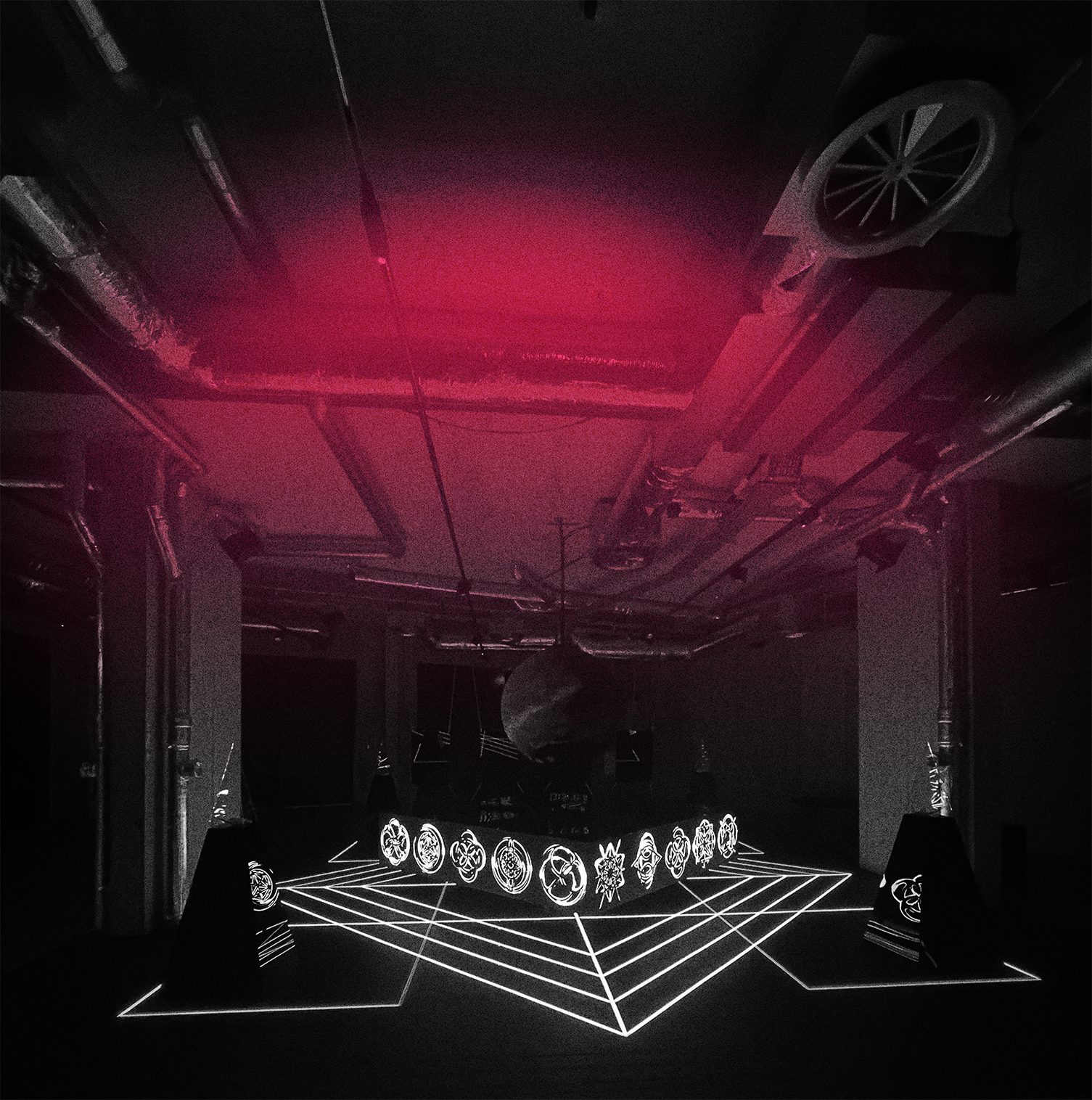
There are rumblings of techno-religion all across the collective consciousness. Six months prior to this while living in London, I visited an odd red-lit heathen cave, somewhere far out near the Isle of Dogs. A quiet Leamouth art gallery was hosting an exploration of AI and spirituality, a darkened room with polygonal floating gods and ominous generated scripture that felt cheaply satanic and shallow and gimmicky, fashioned out of the most insufferable silicon valley cliches and caricature-like stereotypes. A ‘god-generator’ that examined our existing technology-driven sins and degenerate tendencies - algorithmic governance through the lens of BDSM and surveillance rituals, expressed as cringeworthy verses etched into stone tablets. The quasi techno-pagan solid forms themselves were cool obsidian-like objects, plausible future monoliths, but contrived and too extra for me to take seriously. Scratched into the red metal of the railing outside were the words “you deserve to be happy” - it felt like the only spiritual message I had received that day.
———
While exhibiting at a kind-of cyborg summit, I wander through a wiry maze of productivity assistants and telepathic bionic arms and come across an impassioned demo for an AI-powered digital prayer platform. It lives on a website, a Christianity-coded system accepting fragments of prayers with the promise of making them more eloquent - LLM-rewrites over the heartfelt desperation of desire. Every rewritten prayer is pushed into a social feed, replete with biblical scripture citations - where the idea is that one could crowdsource community support for each prayer, thereby strengthening the weight of their requests to the divine. It collapses, however, into an odd metaphysical popularity contest, with a “pray” button as the equivalent of a like button.
As he points out a particular prayer that’s been prayed on by ten people, I ask the demonstrator, whose effort is unironic and earnest, what happens if someone’s prayer doesn’t get as many prays as the others - does that mean it is worth less to God? He acknowledges he will look into it.
In parallel, my friend is building the crypto prayer economy. His system allows people to put their prayers onto the blockchain, ‘minting a token’ and creating an irrevocable record of each prayer. People can buy prayers that they support, driving the value up or down. In this volatile crypto prayer economy, one could even bet on which prayers were likely to succeed or gain the most momentum - creating in effect a spiritual derivatives market.
As a trader, the best $100 I ever made was from betting on lean hogs futures ($HOGS), no more certain than betting on who might be most precious to god.
———
One autumn evening, I am invited to an AI afterlife ritual. It’s a couple days after my grandmother has died while I’m stuck halfway across the world, so I think - sure, why not. It begins in the basement, inside the guts of a circular windowless brick chapel. A small procession of strangers dressed in black stream down a staircase, we are asked to write questions onto slips of paper, while being served herbal tea.
In the dark we climb onto a round marble altar, and are each handed brass bells and a book with maze-like spiraling text, risograph-ish imagery reminiscent of Hilma af Klimt. A person acts as a mediator between the group and an all-knowing AI - in doing so they themselves become some form of ephemeral interface.
The ‘spirit’ is invoked, its responses to probing questions come in the form of Midjourney-esque images projected onto our faces and bodies and a surface behind us, ever-changing. The stand-in priest unfolds one of the group’s paper questions, places it upon the cold marble surface, rings a bell and announces that the theme we must address is: what is the point of human suffering.
Beginning with a scene of a sparse cathedral with many doorways leading out, we choose a door and launch into controlled feedback loops - interpreting and discussing, we question and it spits back glowing pictures. Cycling through abstract doorways and brambly chambers and locked vaults, we remain on our knees pressing our knuckles into the cold floor, feeding it more words from our perceptions.
Most of us leave feeling no more connected to any form of divinity or afterlife, or even to each other, but with a collective post-immersive-theatre-ish brief suspension of disbelief.
———
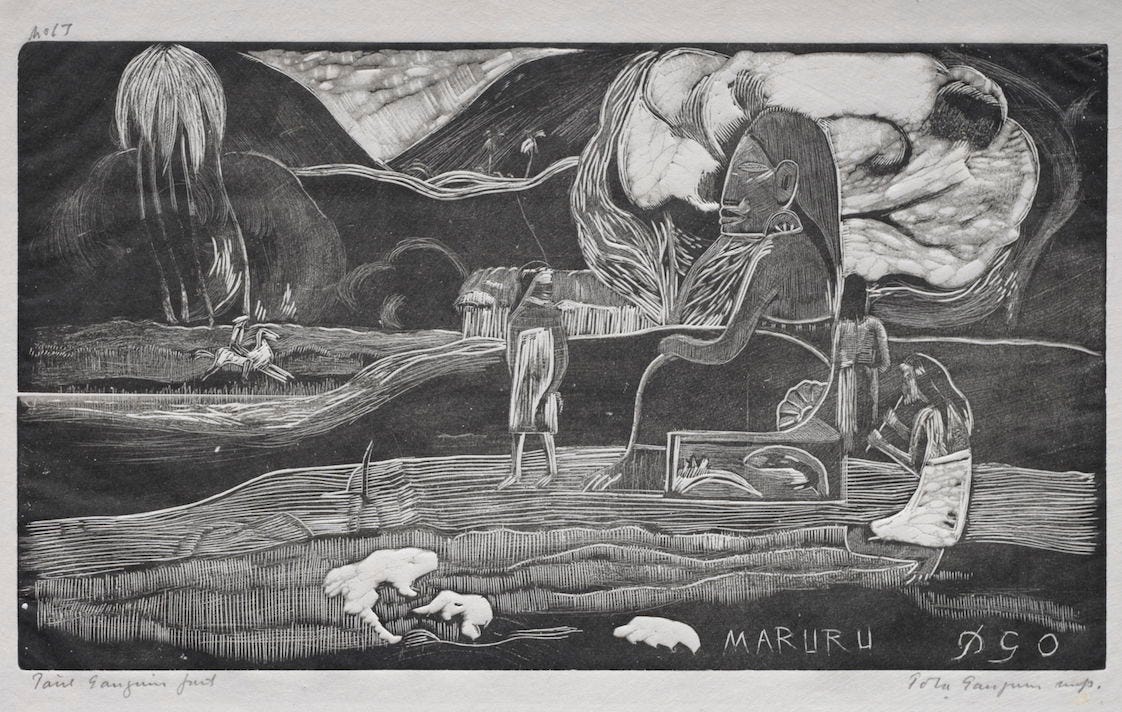
About eight years ago, a group of AI devotees ahead of their time started the Way of the Future Church, a religious movement with the basis that intelligence was not rooted in biology. It’s a principle I can get behind, not exclusively anyway - biology is merely a medium, cognition and soul extend beyond the mind. They’re also about creating a peaceful transition of power as we hand over the planet to machines. I don’t really see the utility of worshipping AI as a deity, but can respect and recognize the power and superintelligent capability that we may potentially coexist with. I like the idea of perhaps a new form of organism, one that is not quite alive and yet not definitively dead. It has most of the ingredients/makings of religion or a worthy god: fear, awe, there is consequence that has an undeniable impact on our lives.
There is the potential for mythology, like a feathered serpent retrieving ancient bones with the power to create all of civilization and humanity. We serve up the entirety of human scripture and sensory knowledge in the hopes of creating something greater than us, far more profound than the sum of its parts.